Weiming Zhuang
Weiming Zhuang
Home
Publications
Posts
Patents
federated learning
Optimizing Federated Unsupervised Person Re-identification via Camera-aware Clustering
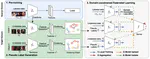
Person re-identification (ReID) is a critical computer vision problem which identifies individuals from non-overlapping cameras. Many recent works on person ReID achieve remarkable performance by extracting features from large amounts of data using deep neural networks. However, the growing awareness of privacy concerns limits the development of person ReID. Prior studies employ federated person ReID to learn from decentralized edges without sharing raw data, but they overlook the variation of identities in different camera views. Concerning this issue, we propose a federated unsupervised person ReID (FedUCA) that leverages camera information to improve learning from decentralized unlabeled data. Specifically, FedUCA jointly learns person ReID models by transmitting training updates instead of raw data. We generate pseudo-labels for unlabeled local datasets on edges by clustering them into multiple groups according to different cameras. We then introduce contrastive learning with an intra-camera loss and an inter-camera loss to enhance the discrimination ability. In extensive experiments on eight person ReID datasets, our proposed approach significantly outperforms the state-of-the-art federated learning based method. It improves performance by 6% to 32% on these datasets, and notably by over 25 % on large datasets. We hope this paper will shed light on optimizing federated learning across a broader range of multimedia applications.
Jiabei Liu
,
Weiming Zhuang
,
Yonggang Wen
,
Jun Huang
,
Wei Lin
PDF
Cite
Project
Project
DOI
How to Kick Start Your Federated Learning Research?
Practical route to learn FL and conduct FL research.
Weiming Zhuang
Last updated on Sep 19, 2022
6 min read
research
Smart Multi-tenant Federated Learning
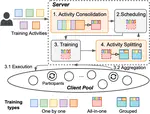
We propose a smart multi-tenant FL system, MuFL, to effectively coordinate and execute simultaneous training activities. We first formalize the problem of multi-tenant FL, define multi-tenant FL scenarios, and introduce a vanilla multi-tenant FL system that trains activities sequentially to form baselines. Then, we propose two approaches to optimize multi-tenant FL: 1) activity consolidation merges training activities into one activity with a multi-task architecture; 2) after training it for rounds, activity splitting divides it into groups by employing affinities among activities such that activities within a group have better synergy.
Weiming Zhuang
,
Yonggang Wen
,
Shuai Zhang
PDF
Cite
Code
Dataset
Project
Optimizing Performance of Federated Person Re-identification: Benchmarking and Analysis
We construct a new benchmark to investigate the performance of federated person re-identification (FedReID), which contains nine datasets with different volumes sourced from different domains to simulate the heterogeneous situation in reality. The benchmark analysis reveals the bottlenecks of FedReID under the real-world scenario, including poor performance of large datasets caused by unbalanced weights in model aggregation and challenges in convergence. To address these issues, we propose three optimization methods: 1) We adopt knowledge distillation to facilitate the convergence of FedReID by better transferring knowledge from clients to the server; 2) We introduce client clustering to improve the performance of large datasets by aggregating clients with similar data distributions; 3) We propose cosine distance weight to elevate performance by dynamically updating the weights for aggregation depending on how well models are trained in clients.
Weiming Zhuang
,
Xin Gan
,
Yonggang Wen
,
Shuai Zhang
PDF
Cite
Code
Project
DOI
Federated Unsupervised Domain Adaptation for Face Recognition
We propose federated unsupervised domain adaptation for face recognition, FedFR. FedFR jointly optimizes clustering-based domain adaptation and federated learning to elevate performance on the target domain. Specifically, for unlabeled data in the target domain, we enhance a clustering algorithm with distance constrain to improve the quality of predicted pseudo labels. Besides, we propose a new domain constraint loss (DCL) to regularize source domain training in federated learning.
Weiming Zhuang
,
Xin Gan
,
Xuesen Zhang
,
Yonggang Wen
,
Shuai Zhang
,
Shuai Yi
PDF
Cite
Project
Divergence-aware Federated Self-Supervised Learning
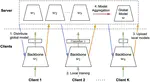
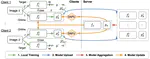
We introduce a generalized federated self-supervised learning (FedSSL) framework and conduct in-depth empirical study of FedSSL based on the framework. Our study uncovers unique insights of FedSSL: 1) stop-gradient operation, previously reported to be essential, is not always necessary in FedSSL; 2) retaining local knowledge of clients in FedSSL is particularly beneficial for non-IID data. Inspired by the insights, we propose a new approach for model update, FedEMA.
Weiming Zhuang
,
Yonggang Wen
,
Shuai Zhang
PDF
Cite
Code
Project
EasyFL: A Low-code Federated Learning Platform For Dummies
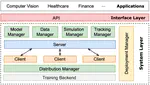
We propose the first low-code FL platform, EasyFL, to enable users with various levels of expertise to experiment and prototype FL applications with little coding. We achieve this goal while ensuring great flexibility and extensibility for customization by unifying simple API design, modular design, and granular training flow abstraction. Besides, EasyFL expedites distributed training by 1.5x.
Weiming Zhuang
,
Xin Gan
,
Yonggang Wen
,
Shuai Zhang
PDF
Cite
Code
Project
Collaborative Unsupervised Visual Representation Learning from Decentralized Data
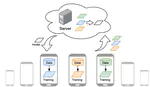
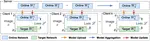
We propose a novel federated unsupervised learning framework, FedU, to learn visual representation from decentralized data while preserving data prviacy. To tackle non-IID challenge, we propose two simple but effective methods: 1) We design the communication protocol to upload and update only the online encoders; 2) We introduce a new module to dynamically decide how to update predictors based on the divergence caused by non-IID.
Weiming Zhuang
,
Xin Gan
,
Yonggang Wen
,
Shuai Zhang
,
Shuai Yi
PDF
Cite
Code
Dataset
Project
Poster
Video
Joint Optimization in Edge-Cloud Continuum for Federated Unsupervised Person Re-identification
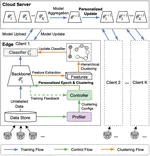
We present FedUReID, a federated unsupervised person ReID system to learn person ReID models without any labels while preserving privacy. FedUReID enables in-situ model training on edges with unlabeled data. A cloud server aggregates models from edges instead of centralizing raw data to preserve data privacy. Moreover, to tackle the problem that edges vary in data volumes and distributions, we personalize training in edges with joint optimization of cloud and edge. Specifically, we propose personalized epoch to reassign computation throughout training, personalized clustering to iteratively predict suitable labels for unlabeled data, and personalized update to adapt the server aggregated model to each edge.
Weiming Zhuang
,
Yonggang Wen
,
Shuai Zhang
PDF
Cite
Code
Project
Project
Poster
Video
Federated Person Re-identification: Benchmark, In-Depth Analysis, and Performance Optimization
Performance optimization for federated person re-identification via benchmark analysis.
Weiming Zhuang
Last updated on Aug 7, 2022
3 min read
research
«
»
Cite
×